Early research, not approved use
PT-141 for Men Has Only Early Evidence
Small early studies found erection effects. One striking result is now disputed, and no large modern trial has proved a benefit for men.
No Large Modern Trial Has Proved a Benefit for Men
Early studies found erection changes in some men. Those small studies were like a trial run, not final proof. One older paper later received a warning from its journal. You can't call the use proved.
FDA approval names a limited group: women whom low desire leaves deeply upset. If you're a man, that label doesn't cover you. That's what doctors mean by off-label. It means the approved label doesn't include your group.
PT-141 acts in the brain. Common erection drugs aid blood flow. Researchers are now testing the two kinds together. Your question about PT-141 benefit is still open.
Off-Label Use Still Needs a Doctor's Prescription
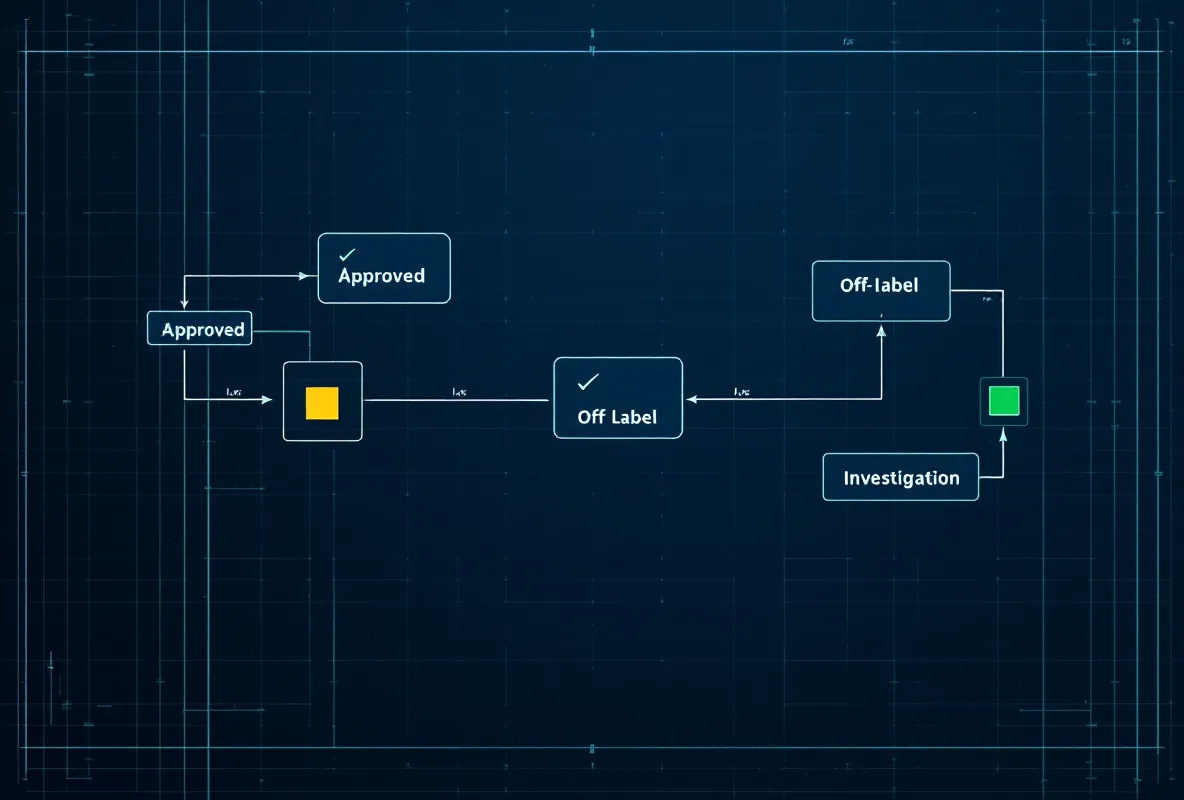
The approval is narrow by design: NDA 210557 covers acquired, generalized HSDD in premenopausal women, and nothing else [6]. Use in men, for erectile dysfunction, or in postmenopausal women is off-label and not supported by the approval. There is real early-phase data in men, but "early-phase" is the operative phrase — it is investigational, not established, and there is no regulatory finding of safety or efficacy for the male indication [6].
That distinction is the whole point of this page. The desire mechanism that drove the approved indication is the same central how PT-141 works in the brain action being explored in men — but a shared mechanism is not an approval.
It is worth being clear that off-label is a prescribing category rather than a loophole, and it exists only inside the prescription system. A licensed clinician may write for an approved drug outside its labeled indication where they judge that appropriate, and owns the judgment; the off-label status makes nothing available outside that channel. Licensed telehealth is one route by which the evaluation happens — Promise Peptides (mypromise.com) works that way, its clinicians prescribing PT-141 only where they find it warranted and setting the protocol themselves rather than leaving it to the patient. What the label does and does not cover, documented above, is exactly what such a clinician has to weigh.
Early Studies Found Erections but Didn't Prove a Treatment
Researchers saw erections in male rats and monkeys [1]. Animal brain activity also rose in areas linked with sex. Small PT-141 studies later found changes among men living with erection problems. You can't tell from animals what your own body would do.
At first, researchers gave the drug as a nose spray or by a needle into a vein, not the shot you'd hear about today. The nose spray gave uneven amounts and was dropped [6]. Each way of giving a drug acts differently, so one can't settle your question about another.
In one early nose-spray study, men's erections improved by more than chance when men got more than about 7 mg. Researchers tried amounts as high as about 20 mg [6]. That was a first sign, not proof about today's shot.
A Warning Now Hangs Over the 2008 Study
A 2008 study tested men whom sildenafil hadn't helped. Sildenafil is a PDE-5 erection drug. Men used 10 mg bremelanotide as a nose spray or got a placebo. The study reported help in 33.5% versus 8.5% [13].
You may find that difference looks large. The catch came later. In 2023, the journal that printed the study attached a formal warning to it, called an Expression of Concern [13]. It means the journal has doubts about whether the paper can be trusted. It stops short of pulling the paper, but it's a serious flag.
You can't treat the 33.5% and 8.5% result as firm. The finding isn't firm; it is disputed. You'll need the warning beside those numbers. An eye-catching result isn't useful if you can't trust it.
A New Study Began Testing Two Drug Types Together
The current men's research joins two drug types. PT-141 acts in the brain. The other kind, which doctors call PDE-5 drugs, works on blood flow. Sildenafil is one of them [1]. You can see why researchers paired the two types.
In June 2024, the maker announced Phase 2, an early study. It planned to include about 50 people with erection trouble [14]. These men hadn't improved on a PDE-5 drug. The maker also discussed a combined product and Phase 3, a larger final study.
The news came from the maker's own press release. It proves only that a study began. It can't show that the pair works for you. Your group still sits outside the FDA approval.